


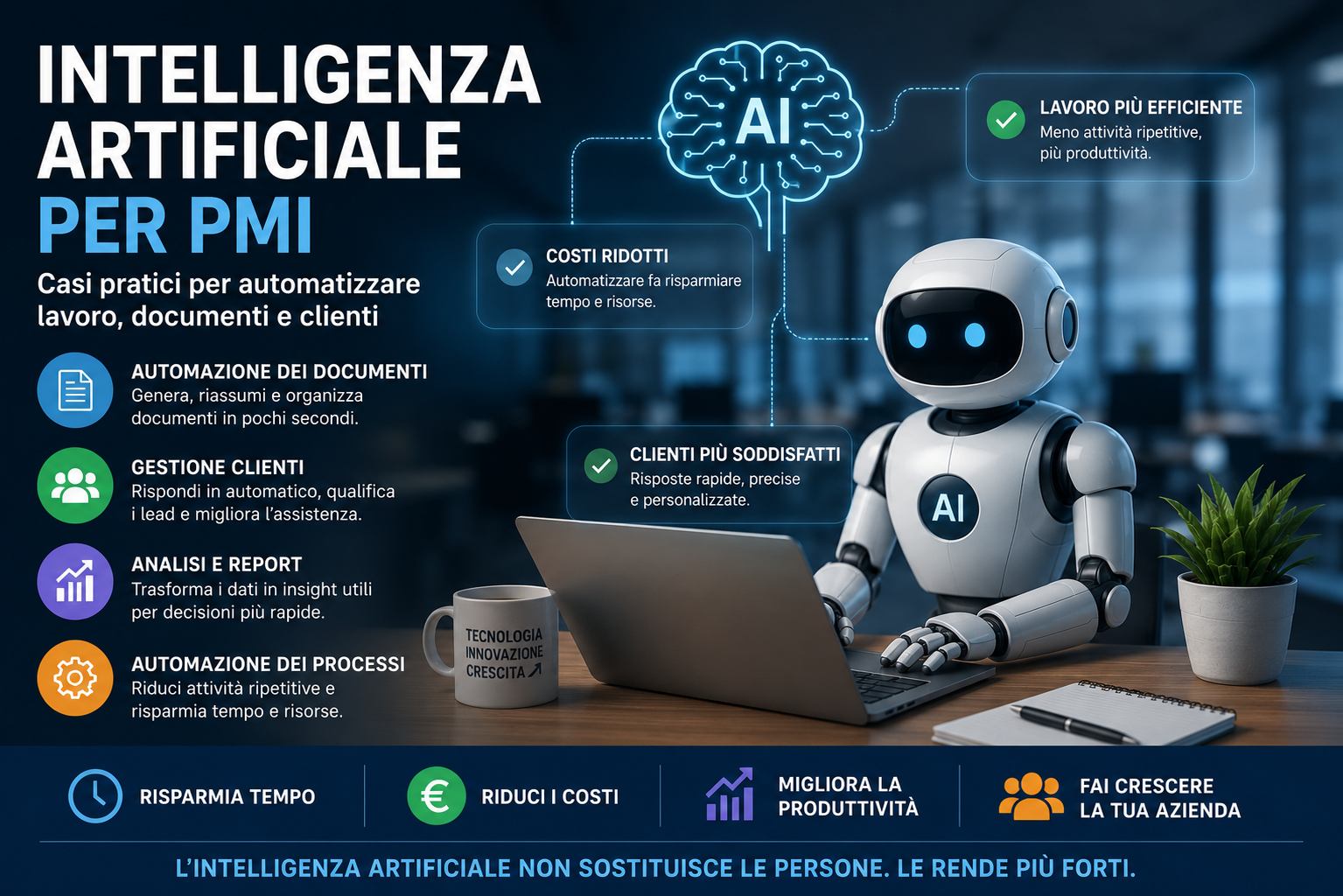
Artificial Intelligence for SMEs is no longer a topic reserved for large companies or highly specialized departments. In 2026, small and medium-sized businesses, professional studios, local activities and structured organizations can also use AI tools to simplify daily tasks, automate documents, improve customer management and reduce the time spent on repetitive operations.
The real value of AI is not only in generating texts or images, but in its ability to support concrete processes. An SME can use Artificial Intelligence to organize information, prepare drafts, analyze data, classify requests, create content, improve customer service and make internal work more efficient.
Why AI is useful for SMEs too
Many small businesses work with limited resources, tight deadlines and staff involved in several activities at the same time. In this context, AI can become an operational support tool, capable of speeding up tasks that take time but do not always create strategic value.
This does not mean replacing people, but helping them work better. Artificial Intelligence can reduce manual activities, improve data organization, provide drafts to review, suggest replies, generate summaries and make complex information easier to manage.
The most interesting practical cases
An SME can introduce AI gradually, starting from the simplest and most repetitive processes. The goal should not be to automate everything, but to identify the activities where AI can bring an immediate and measurable advantage.
Among the most useful practical cases we find:
- Creation of drafts for emails, offers, quotations and communications.
- Automatic summarization of documents, meetings and conversations.
- Classification of customer requests.
- Support for managing FAQs and recurring answers.
- Analysis of sales data, reports and spreadsheets.
- Production of content for blogs, social media and newsletters.
- Automation of repetitive administrative tasks.
- Support for internal training and business documentation.
These uses do not necessarily require complex projects. Often it is enough to integrate existing tools with clear procedures, human checks and well-defined goals.
Automating documents and communications
One of the most immediate areas for AI is document management. Many companies produce emails, reports, commercial offers, product sheets, meeting notes, internal procedures and customer replies every day. Part of this work can be accelerated through templates, prompts and assisted generation tools.
AI can help create a first draft, transform notes into structured text, correct the tone of a communication, summarize long documents or adapt content to different recipients. Human review remains essential, but the time needed to reach a usable version can be greatly reduced.
Customer management and customer service
SMEs often receive repetitive requests: information about services, opening hours, appointments, status of a case, availability, approximate costs or required documents. AI can support the management of these requests through chatbots, assisted response systems, advanced FAQs or automatic message classification.
This does not mean eliminating human contact, but making it more efficient. Simple questions can be handled quickly, while more complex requests are managed by people with better context. In this way, response times, errors and operational workload are reduced.
AI, data and business decisions
Another very useful area concerns data analysis. Even a small business produces valuable information: sales, quotations, customer requests, tickets, appointments, marketing campaigns, web traffic and service performance. Often this data already exists, but it is not analyzed systematically.
AI can help read reports, identify trends, summarize results, compare periods, highlight anomalies and suggest areas for improvement. Decisions remain in the hands of the entrepreneur or manager, but they can be supported by more organized and understandable information.
Automation of internal processes
AI becomes even more effective when it is connected to automation. For example, a request received through a form can be classified, forwarded to the correct department, entered into a CRM and transformed into a preliminary reply. In the same way, a document can be archived, renamed and linked to a case.
These automations reduce manual steps, prevent oversights and improve traceability. For an SME, even automating small recurring activities can generate significant time savings and make the organization more orderly.
Risks, limits and human control
Artificial Intelligence offers many advantages, but it must be used carefully. AI tools can generate inaccurate answers, misunderstand a context, produce unverified content or handle sensitive information inappropriately if clear rules are not defined.
For this reason, it is essential to maintain human control over important processes. Official documents, personal data, delicate communications, economic decisions and confidential information must always be checked by a competent person. AI should be a support tool, not a replacement for business responsibility.
Training and method of use
To achieve concrete results, simply activating an AI tool is not enough. People must be trained, procedures must be defined, work models must be created and it must be clear what can be automated and what requires supervision. The quality of the output depends greatly on the quality of the instructions provided and the clarity of the process.
An SME should start from simple use cases, measure the time saved, collect feedback from users and improve gradually. The right approach is practical and progressive: small well-managed results are worth more than large uncontrolled projects.
The role of Azienda Digitale
In this scenario, Azienda Digitale can help SMEs, professionals and organizations introduce Artificial Intelligence in a practical, secure and results-oriented way. The goal is not to follow a technology trend, but to identify where AI can produce real value in daily processes.
Automating documents, internal work and customer management means freeing up time, reducing errors and improving service quality. With the right method, AI can become an accessible tool even for small businesses, transforming repetitive activities into faster, more organized and more controllable processes.
Questions and Answers
Is Artificial Intelligence useful for a small business?
Yes. Even a small business can use AI to speed up documents, communications, customer support, data analysis and repetitive activities.
Can AI completely replace staff?
No. AI should be seen as a support tool. Decisions, checks and the most sensitive communications must remain under human control.
Where should an SME start?
It is best to start from simple and frequent activities, such as emails, summaries, FAQs, request management and internal documents, measuring the time saved.
Are there risks in using AI?
Yes. The main risks concern inaccurate information, sensitive data management, uncontrolled use of tools and lack of human verification.
Do you want to introduce Artificial Intelligence into your SME in a practical, secure and truly useful way?
Azienda Digitale
can help you automate documents, processes and customer management with digital solutions suited to your business.