


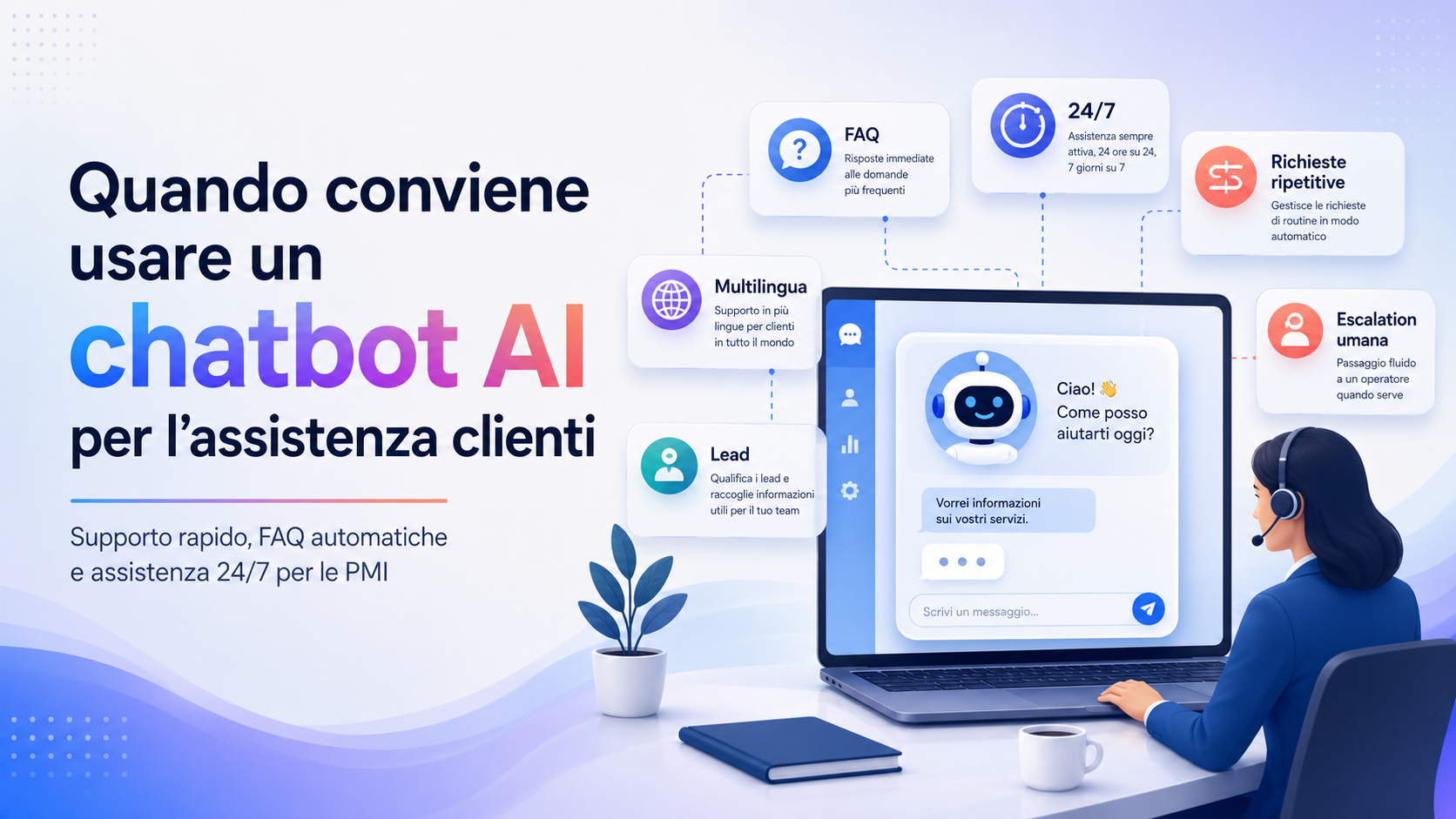
When is it worth using an AI chatbot for customer support? The answer depends on the number of enquiries received, their complexity, service hours and the company’s ability to keep the information used by the system up to date. A chatbot can answer frequently asked questions, collect initial details, route enquiries to the correct department and help support staff spend less time on repetitive activities.
A chatbot should not be introduced simply because artificial intelligence is widely discussed and adopted. When it is configured without clear objectives, it may provide inaccurate answers, frustrate customers and prevent them from reaching a person quickly. Automation is useful when it simplifies the customer journey and supports employees, not when it creates another barrier between the business and someone who needs assistance.
The most effective solution is often a hybrid model: the chatbot handles straightforward and recurring enquiries, while employees manage complex, sensitive or unexpected cases. This allows the company to provide faster responses without removing the value of human interaction.
What an AI customer-support chatbot is
An AI chatbot is a system that interacts with users through written or spoken messages. It can be installed on a website, integrated into an application, connected to a messaging platform or used within a customer portal.
Unlike a chatbot based exclusively on buttons and predefined responses, an AI-powered system can interpret questions expressed in different ways, identify the subject of an enquiry and prepare an answer using an approved business knowledge base.
The system does not understand a situation in the same way as a person. It may misinterpret a question, use outdated information or produce an answer that appears convincing but is inaccurate. It must therefore operate within defined limits, use verified content and always provide a way to transfer the conversation to a human agent.
Traditional chatbots, AI chatbots and agent-assistance tools
Before selecting a solution, it is useful to distinguish between three different forms of customer-support automation.
- Traditional chatbot: provides menus, buttons and responses defined in advance. It is easy to control but has difficulty handling freely worded questions.
- Customer-facing AI chatbot: interprets natural language and generates answers using authorised business information.
- AI assistant for support agents: does not respond directly to the customer but suggests replies, summarises conversations and retrieves information for employees.
A company does not necessarily need to begin with a fully autonomous chatbot. In many cases, it is safer to use AI initially as an internal assistant, allowing an employee to review and send each reply.
After accuracy, usefulness and error frequency have been assessed, selected low-risk responses can gradually be automated. This approach reduces the risks of immediately introducing a system that has not yet been adequately tested.
When the volume of recurring enquiries is high
An AI chatbot may be worthwhile when the support team receives many similar questions every day. Opening hours, payment methods, order status, return procedures, required documents, service features and booking arrangements are examples of enquiries that can be handled through standardised information.
In these situations, the chatbot reduces the number of conversations that employees must open and process manually. The team can focus on problems requiring analysis, authorisation, technical investigation or knowledge of the customer’s specific circumstances.
Before implementation, the company should analyse emails, tickets and calls received over the previous months. When a significant proportion concerns the same topics, a chatbot is more likely to provide a measurable benefit.
When an initial response is required outside business hours
A chatbot can provide an initial level of assistance when employees are unavailable. It can communicate opening hours, collect an enquiry, identify its topic, provide basic information or create a ticket for the team to review when the office reopens.
This should not be presented as continuous human support when no employee is available. The system must distinguish clearly between an automated response, acknowledgement of the enquiry and direct assistance from a person.
Urgent situations require alternative channels, dedicated telephone numbers or specific procedures. A general-purpose chatbot should not be the only point of contact when an interruption may cause damage, block an essential service or require immediate action.
When customers must be routed to the correct department quickly
Many enquiries are delayed because they reach the wrong department or do not include the information needed to begin working on them. A chatbot can ask about the topic, relevant product, order number and type of problem before directing the conversation to technical support, administration, sales or billing.
This initial classification can reduce internal transfers and provide the support agent with an already organised request. The system should still offer a general category for cases it cannot interpret.
Initial questions must be limited and relevant. A lengthy process that forces users to answer numerous questions before they can speak to a person may turn automation into a barrier.
When the company has a reliable knowledge base
An AI chatbot is useful only when it has access to accurate information. Manuals, procedures, terms of service, product sheets, return policies and frequently used answers must be current, organised and approved.
The system should answer using a controlled knowledge base rather than freely generating information about subjects it does not understand. When it cannot find a reliable answer, it should say so and transfer the conversation to a person.
The quality of the chatbot therefore depends on the quality of the company’s content. When procedures are contradictory or incomplete, artificial intelligence cannot automatically correct the problem and may reproduce the same inconsistencies in its answers.
When employees spend too much time searching for information
A chatbot can also support customer-service employees. During a conversation, it may locate a procedure, summarise previous messages, suggest an answer or show the steps required to manage the enquiry.
This approach is particularly useful when information is distributed across manuals, documents, emails, internal pages and management systems. AI can reduce the time required to find the appropriate content while leaving final verification to the employee.
An internal assistant may be a lower-risk first project than a public chatbot because each response is reviewed before being communicated to the customer.
When collecting leads and commercial enquiries
A chatbot can collect initial information from a potential customer by asking which service is of interest, the size of the organisation, its location, the required timeframe and the preferred contact method.
It may also suggest an appointment, provide a brochure, direct the user towards a quotation or create an enquiry for the sales team. In this context, the chatbot does not replace consultation but organises the information required to begin the conversation.
Requested fields should be proportionate to the purpose. A straightforward contact request does not require financial information, identity documents or extensive details that can be requested later through a more secure channel.
When customer support is provided in several languages
An AI chatbot can help manage questions in several languages by translating enquiries and preparing responses from the same knowledge base. This may be useful for companies with international customers or websites published in multiple languages.
Automatic translation should be reviewed carefully when it concerns contractual conditions, technical instructions, warranties, payments or information that could be interpreted differently.
The company should specify which languages are officially supported and transfer the conversation to a person when the system is not sufficiently confident about the interpretation or proposed response.
When a chatbot is not the right solution
A chatbot is not always the most appropriate channel. Certain conversations require empathy, negotiation skills, specific authorisations or a detailed understanding of the circumstances.
A person should normally become involved in cases concerning:
- Complex complaints or highly dissatisfied customers.
- Financial disputes and non-standard refund requests.
- Technical problems requiring detailed diagnosis.
- Urgent or potentially dangerous situations.
- Decisions with legal, financial or contractual consequences.
- Health, judicial or other particularly sensitive information.
- Vulnerable customers or people experiencing communication difficulties.
- Cases not covered by the knowledge base.
The system must recognise its limitations. A response such as “I do not have enough information, so I will transfer you to an agent” is more useful than an invented explanation.
Transferring to a human agent must be easy
One of the main causes of dissatisfaction is the inability to leave an automated process. Customers repeat the same question, receive irrelevant replies and cannot find a way to speak to a person.
A transfer should take place when:
- The user explicitly requests a person.
- The chatbot repeatedly fails to understand the question.
- The enquiry belongs to a sensitive category.
- The answer requires authorisation.
- The customer expresses dissatisfaction or urgency.
- The available information is insufficient.
- The system’s confidence level is too low.
When the conversation is transferred, the agent should receive a summary and the details already provided. Asking the customer to start again removes much of the benefit created by the chatbot.
Clearly stating that the customer is interacting with AI
The customer should understand who or what they are interacting with. A chatbot should not use an identity or language designed to make it appear to be a real person.
At the beginning of the conversation, the company should state that it is a virtual assistant, explain what it can do and show how to request a human agent. From 2 August 2026, the transparency obligations under the AI Act will require people to be informed when they are interacting directly with an AI system, unless this is already obvious.
Transparency increases trust and allows users to assess responses more carefully. A complex notice is not required: a short and clear message is generally more effective.
Protecting personal information during conversations
During a chat, customers may voluntarily enter names, addresses, order numbers, contact details, documents and detailed descriptions of their problems. The company must therefore define which information is genuinely necessary and how it will be used.
A chatbot should not ask for passwords, one-time authentication codes, full payment-card numbers or other credentials. When a payment, confidential change or document upload is required, the user should be directed to a protected area designed for that specific operation.
The company should also define how long conversations are retained, who can access them and whether they will be used to improve the system. Unnecessary information should be excluded or deleted according to defined procedures.
Connecting the chatbot to business systems carefully
A chatbot can be integrated with a CRM, e-commerce platform, ticketing system, calendar or business-management application. These integrations may allow it to check a request, create an appointment or retrieve information about an order.
Every connection increases the amount of information available to the system. Permissions must be limited to the operations that are genuinely required. A chatbot that only needs to read an order status should not be able to modify all customer information or access accounting records.
Sensitive actions should require an additional confirmation or intervention from an employee. Address changes, cancellations, refunds, payments and irreversible operations should not be performed solely on the basis of an unauthenticated conversation.
Protecting the chatbot against manipulation and misuse
A user may attempt to persuade the system to ignore its instructions, disclose confidential information or use functions outside its intended purpose. Documents and content connected to the knowledge base may also contain misleading instructions.
To reduce risk, internal instructions must remain separate from customer content, available tools should be restricted, attachments must be checked and performed operations should be monitored. The chatbot should not have unrestricted access to folders, databases and applications.
Activity logs, alerts for unusual behaviour, usage limits and a procedure for rapidly disabling the system or a particular integration should also be provided.
Creating and maintaining a high-quality knowledge base
The knowledge base should contain only approved information relevant to customer support. Every document should have an owner, an update date and, where appropriate, a review deadline.
Outdated versions should be removed and contradictions resolved. When two procedures provide different instructions, the chatbot may choose the wrong one or combine incompatible information.
Important answers may be linked to predefined templates, while more flexible wording can be permitted for lower-risk subjects. The company must still monitor conversations and correct responses that cause errors or misunderstandings.
How to measure whether the chatbot is genuinely useful
Success should not be measured only by the number of conversations handled automatically. A chatbot may close many contacts without actually resolving the underlying problems.
Useful indicators include:
- Percentage of enquiries resolved without human intervention.
- Number of conversations transferred to an agent.
- Average time required to receive a useful response.
- Percentage of users who abandon the conversation.
- Number of correct, incomplete and incorrect answers.
- Customer satisfaction.
- Reduction in repetitive tickets.
- Time saved by support employees.
- Number of enquiries that need to be reopened.
- Privacy or access-related incidents.
Unresolved conversations are particularly useful because they reveal missing content, misunderstood questions and processes that need to be improved.
How to introduce the chatbot gradually
It is preferable to begin with a limited project covering a small group of questions. The chatbot can first be tested internally or made available only in one section of the website.
An implementation plan may include:
- Analyse enquiries received during previous months.
- Identify frequent, low-risk questions.
- Define the results the system should produce.
- Prepare and verify the knowledge base.
- Establish which information may be collected.
- Configure the transfer to a human agent.
- Test correct, incomplete, ambiguous and manipulative questions.
- Run a pilot project with a limited number of users.
- Monitor errors, complaints and abandoned conversations.
- Extend the functions only after a positive assessment.
A gradual introduction allows the company to improve the system without immediately entrusting it with critical processes or large quantities of information.
Common mistakes to avoid
One of the most common mistakes is treating a chatbot as a project that only needs to be installed once. Information changes, customers ask new questions and company procedures are updated. The system therefore requires continuous maintenance.
Other mistakes include:
- Hiding the fact that the customer is interacting with AI.
- Failing to provide a simple way to contact a person.
- Using unverified or outdated documents.
- Allowing the chatbot to answer questions about any subject.
- Collecting more personal information than necessary.
- Requesting credentials or payment information in the chat.
- Connecting the system to complete archives with excessive permissions.
- Automating refunds, cancellations and sensitive decisions without oversight.
- Measuring only the number of automated conversations.
- Failing to analyse errors, abandoned conversations and requests for human support.
An effective chatbot should not attempt to answer every question. It should know when to provide information, when to ask for clarification and when to transfer the customer to a person.
The role of Azienda Digitale
In this context, Azienda Digitale can support SMEs, professionals and organisations in assessing, designing and introducing AI chatbots for customer support. The analysis should begin with the enquiries actually received, the channels in use, existing systems and the objectives of the service.
Support may include organising the knowledge base, defining conversation flows, configuring accounts, integrating the chatbot with the website and business software, protecting information, training agents and monitoring results.
An AI chatbot is worthwhile when it reduces repetitive activities, provides rapid responses and allows employees to spend more time on cases requiring expertise and empathy. It should not replace every human interaction, but make customer support more accessible, organised and consistent.
Frequently Asked Questions
Can an AI chatbot completely replace customer-service agents?
Generally, no. It can manage simple recurring questions, collect information and prepare answers. Complaints, complex cases, sensitive decisions and unexpected situations require a person.
Must customers be told that they are speaking to a chatbot?
Yes, this should be stated clearly. From 2 August 2026, the AI Act’s transparency obligations will require people to be informed when they are interacting directly with an AI system, unless this is already obvious.
Which information should not be requested through a chatbot?
Passwords, one-time codes, full card numbers, credentials and unnecessary confidential information should not be requested. Sensitive operations should use an authenticated and protected area.
Can a chatbot check the status of an order?
Yes, when it is securely integrated with the business system and verifies the user’s identity where necessary. Its permissions should be limited to the information required for the enquiry.
How can the company prevent the chatbot from inventing answers?
It should use a verified knowledge base, operate within limited subjects, apply rules for uncertain cases and transfer the conversation to an agent when no reliable answer is available.
Which enquiries should an SME automate first?
It is preferable to begin with opening hours, services, bookings, required documents, standard procedures and other frequent questions that do not require complex decisions or particularly sensitive information.
Would you like to understand whether an AI chatbot could improve your company’s customer support?
Azienda Digitale
can help you design a useful and secure solution that integrates with your processes while keeping human support available.