


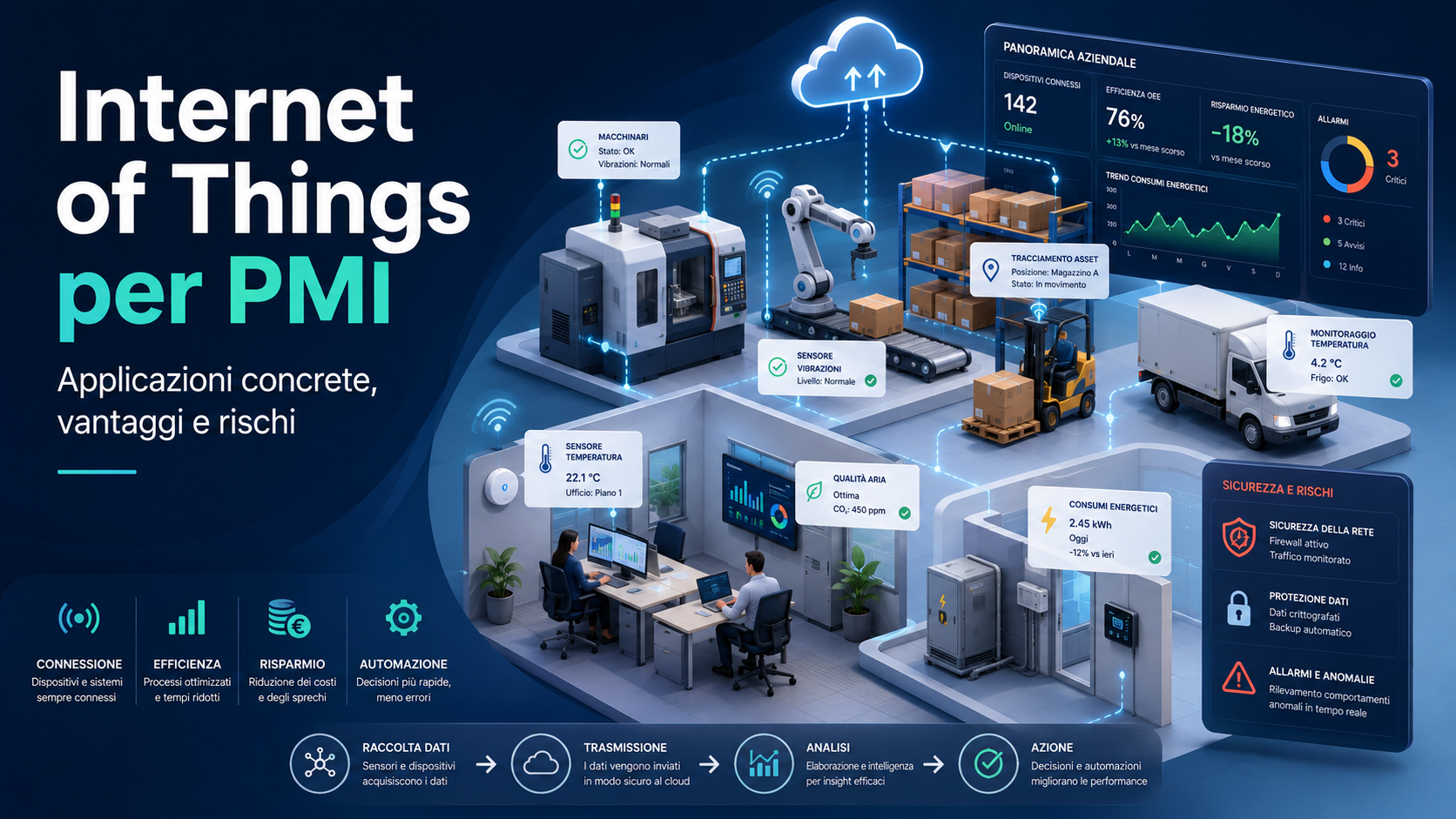
The Internet of Things allows machines, sensors, vehicles, meters, shelves, equipment and other physical objects to collect data and communicate with business software. For an SME, this technology can make information visible that was previously checked manually, including temperature, energy consumption, equipment location, machine condition and stock availability.
The value of IoT does not depend on the number of connected devices. A project produces results when collected information is used to prevent failures, reduce waste, automate inspections or improve operational decisions. Without clear objectives, integration, security and ownership, connected devices can instead increase cost, complexity and exposure to cyber risks.
What the Internet of Things is
The Internet of Things, commonly abbreviated to IoT, describes physical objects equipped with sensors, software and communication capabilities. They may connect to a local network, the Internet or a dedicated business platform.
An IoT system may include:
- Temperature, humidity, pressure and vibration sensors.
- Smart electricity, water and gas meters.
- Vehicle and asset-tracking devices.
- Cameras and access-control systems.
- Network-connected industrial machinery.
- Tagged products, containers and shelves.
- Gateways that collect and transmit information.
- Cloud or on-premises management platforms.
Devices do not always need a direct Internet connection. In many projects they communicate with a local gateway that filters data and forwards it only to authorised systems.
Why IoT can be useful for SMEs
Small and medium-sized companies often need to reduce waste, downtime and repetitive inspections while working with limited resources. IoT can transform certain processes from reactive to preventive by providing continuous measurements rather than occasional manual checks.
It may be useful when a company needs to:
- Monitor equipment across several locations.
- Receive alerts before a parameter exceeds a limit.
- Locate tools, vehicles and materials.
- Measure consumption and identify waste.
- Record environmental conditions automatically.
- Reduce repetitive inspection work.
- Review machine status remotely.
- Connect physical events with orders, customers and projects.
The project should begin with a specific operational problem. Installing sensors without defining who will use the information and which decision it will support rarely produces a measurable benefit.
Production and machinery maintenance
In manufacturing environments, sensors can measure temperature, vibration, electrical consumption, operating cycles and other parameters that provide information about machine condition.
Applications include:
- Detection of unusual behaviour.
- Monitoring of actual operating hours.
- Maintenance scheduled according to usage.
- Warnings about overheating and abnormal vibration.
- Measurement of machine downtime.
- Comparison between machines, lines and shifts.
- Automatic recording of process parameters.
The objective is not to predict every failure with certainty, but to identify signals that allow maintenance before a problem causes extended downtime or more expensive damage.
Warehouse, logistics and asset tracking
Tags, sensors and location devices can help identify the position and condition of materials, containers, tools and vehicles. This reduces search time and improves the traceability of physical movements.
An SME may use IoT to:
- Locate shared tools and equipment.
- Track the movement of containers.
- Monitor temperature and humidity during transport.
- Record how long materials remain in a specific area.
- Generate alerts when an asset leaves an authorised zone.
- Monitor vehicles, deliveries and routes.
- Connect physical movements to management-system records.
Tracking accuracy should reflect the value of the asset and the genuine business requirement. Highly precise systems may require more infrastructure, energy and maintenance than simple area-based tracking.
Energy, buildings and facilities
Smart meters and environmental sensors can show how electricity, lighting, heating, cooling and other facilities are being used. Companies can identify out-of-hours consumption, unusual peaks and inefficient areas.
Possible applications include:
- Consumption monitoring by site, department or machine.
- Lighting and equipment controls based on schedules or occupancy.
- Temperature and air-quality monitoring.
- Water-leak alerts.
- Monitoring of pumps and technical systems.
- Collection of data for efficiency projects.
- Warnings when values become unusual.
Automatic controls should include limits, verification and manual override options. A faulty sensor should not be able to control a critical installation without safeguards.
Retail, hospitality and customer-facing businesses
In shops and service environments, IoT can support environmental monitoring, equipment availability and energy management without requiring complex industrial infrastructure.
Practical examples include:
- Monitoring refrigerators and cold rooms.
- Controlling access to restricted locations.
- Managing lighting according to occupancy.
- Reporting unavailable equipment.
- Measuring the use of rooms and assets.
- Generating alerts when consumables run low.
- Monitoring systems at unattended locations.
When information can be associated with identifiable people, the organisation should distinguish data required for the service from information that would merely be interesting to collect.
Agriculture, food production and cold chains
Environmental sensors and connected devices can support farms, greenhouses, food facilities, warehouses and temperature-controlled transport.
Applications may include:
- Soil-moisture measurement.
- Temperature and ventilation monitoring in greenhouses.
- Automated irrigation planning.
- Monitoring of silos, cold rooms and warehouses.
- Temperature recording during transport.
- Alerts for cold-chain interruptions.
- Remote monitoring of pumps, tanks and installations.
Continuous information can improve response times and control records, but sensors still require calibration, maintenance and periodic verification.
Practical business benefits
IoT produces value when it changes how the company operates. Benefits may result from lower costs, avoided damage, better service or greater operational capacity.
Common benefits include:
- Fewer manual inspections.
- Faster identification of anomalies.
- Reduced downtime.
- Lower energy waste.
- Improved tracking of materials and assets.
- Automatic recording of operating conditions.
- Better maintenance planning.
- Decisions based on more current information.
- New monitoring services for customers.
The company should measure results before and after implementation. A dashboard containing many charts is not proof that the underlying process has improved.
How an IoT system is structured
An IoT project involves more than a sensor. The complete service depends on devices, networks, gateways, platforms, applications and users.
The main components are:
- Device: measures a parameter or performs an action.
- Network: carries information through cables, WiFi, mobile or low-power technologies.
- Gateway: collects, converts and filters communications.
- Platform: stores, analyses and displays information.
- Business application: connects measurements with maintenance, orders and customers.
- Rules and automation: generate alerts, tasks and commands.
- Users: review results and manage exceptions.
A failure at any level can affect the complete service. The architecture must therefore be assessed as a whole rather than only according to sensor prices.
Selecting the appropriate connectivity
Connectivity should be selected according to distance, energy consumption, data volume, physical obstacles, mobility and network availability.
Options may include:
- Wired connections for fixed devices in controlled locations.
- WiFi for offices, shops and buildings with suitable coverage.
- Mobile networks for vehicles, construction sites and remote facilities.
- Bluetooth for short-distance communication.
- Low-power technologies for battery-operated sensors.
- Local gateways where Internet access is limited.
Not every measurement must be transmitted in real time. Sending only events, changes or summaries can reduce traffic, energy use and recurring costs.
The main security risks
Every connected device is an asset that must be inventoried, configured and maintained. Forgotten equipment, default passwords and unsupported software can become weaknesses in the business network.
Important risks include:
- Unauthorised access to devices.
- Modification of settings and commands.
- Interception of communications.
- Weak or shared passwords.
- Outdated firmware and unpatched vulnerabilities.
- Devices connected directly to the main company network.
- Unnecessary services and ports left enabled.
- Loss of access when a cloud service is unavailable.
- Dependence on products that are no longer supported.
Security should be designed before deployment. Correcting hundreds of distributed devices can be far more difficult than configuring a controlled pilot correctly.
How to secure IoT devices and networks
IoT devices should be treated as managed technology assets rather than simple accessories. They need lifecycle management from purchase to disposal.
Important measures include:
- Immediate replacement of default credentials.
- Individual management accounts.
- Multi-factor authentication for administration platforms.
- Separation from employee and server networks.
- Communication restricted to necessary systems.
- Regular firmware updates.
- Removal of unused functions and services.
- Encrypted communications where supported.
- Logging of access and important events.
- Procedures for replacing and retiring devices.
A sensor should be able to communicate with its authorised gateway or platform without automatically receiving access to workstations, servers and business files.
Privacy and data management
Not all IoT information is anonymous. Access logs, movement information, vehicle locations and equipment-usage data may be linked to employees, customers, suppliers or visitors.
Before collecting information, the company should define:
- Which data is genuinely required.
- The purpose for which it will be used.
- Who may access it.
- How long it will be retained.
- Whether it will be transferred to external suppliers.
- How it will be protected and deleted.
- Which information must be provided to affected people.
- Whether the data will also be used to evaluate employees.
Collecting every available measurement increases cost and responsibility. Only information required for the process should be retained for an appropriate period.
Integration with ERP, CRM and management software
IoT information becomes more useful when it enters existing business processes. An alert can create a maintenance task, update a project, stop a delivery or notify a site manager.
Integrations may:
- Open a support ticket automatically.
- Create a maintenance order.
- Update machine status.
- Connect an anomaly to a customer or contract.
- Update asset availability and location.
- Generate inspection and expiry reminders.
- Insert measurements into management reports.
The company must establish the primary data source and define how failures, duplicates and temporary outages will be managed.
Costs and long-term sustainability
The cost of an IoT project is not limited to the device. Installation, connectivity, platform licences, integration, maintenance and future replacement must also be considered.
The total cost may include:
- Sensors, gateways and accessories.
- Installation and configuration.
- Connectivity and data plans.
- Platform licences.
- Data storage.
- Dashboards, reports and notifications.
- Software integration.
- Maintenance and updates.
- Battery and device replacement.
- Support and incident management.
- Employee training.
Costs should be estimated over several years and compared with avoided downtime, reduced consumption, saved working hours and new services.
How to start an IoT project step by step
- Identify one specific operational problem.
- Measure the initial situation.
- Define the required data, frequency and accuracy.
- Identify users and the process owner.
- Review network coverage and environmental conditions.
- Select supported and updateable devices.
- Design security and network segmentation.
- Install a limited number of sensors.
- Test alerts, failures and loss of connectivity.
- Connect information with business workflows.
- Compare results with project costs.
- Expand only after validating the pilot.
The pilot should also test unusual situations, including low batteries, unavailable sensors, inconsistent readings and external service interruptions.
Common mistakes to avoid
- Purchasing sensors without a measurable objective.
- Connecting devices directly to the main business network.
- Keeping default credentials.
- Selecting products without updates or support.
- Failing to assess coverage and battery life.
- Collecting data that nobody uses.
- Ignoring privacy and retention periods.
- Failing to connect alerts with owners and tasks.
- Depending completely on Internet connectivity.
- Failing to prepare for broken devices.
- Underestimating recurring and replacement costs.
- Expanding before the pilot has been validated.
An IoT system must remain reliable after the initial installation. Inventory, updates, controls and responsibilities must therefore be maintained for the complete lifecycle.
The role of Azienda Digitale
In this context, Azienda Digitale can support SMEs, professionals and organisations in evaluating and implementing IoT solutions. The work can begin with an analysis of the process, installations, network and information required to obtain a practical result.
Support may include pilot design, connectivity selection, device configuration, network segmentation, CRM and ERP integration, dashboards, automation, access control and user training.
The Internet of Things can help an SME monitor assets, consumption and distributed operations. To produce value, it must be integrated into business processes and supported by security, maintenance and clearly assigned responsibilities.
Frequently Asked Questions
Is IoT suitable for small businesses?
Yes. An SME can begin with a limited number of devices addressing a specific problem, such as temperature, energy consumption or equipment-location monitoring.
What is the difference between an IoT sensor and an ordinary electronic device?
An IoT sensor can transmit its measurements to a platform, generate alerts and connect the information with business processes rather than only displaying a local value.
Are IoT devices secure?
Security depends on the product and configuration. Default credentials, outdated firmware and unsegmented networks increase risk, while updates, limited permissions and monitoring reduce it.
How much does an IoT project cost?
The cost depends on devices, coverage, connectivity, platforms and integrations. Maintenance, batteries, licences and support should be included in a multi-year estimate.
Which application should an SME implement first?
It should choose a frequent, measurable and clearly defined process in which automatically collected data can reduce inspections, prevent damage or improve a decision.
Would you like to understand how connected devices and sensors can improve processes, consumption and maintenance in your company?
Azienda Digitale
can help you design a secure and measurable IoT project integrated with your business systems.