


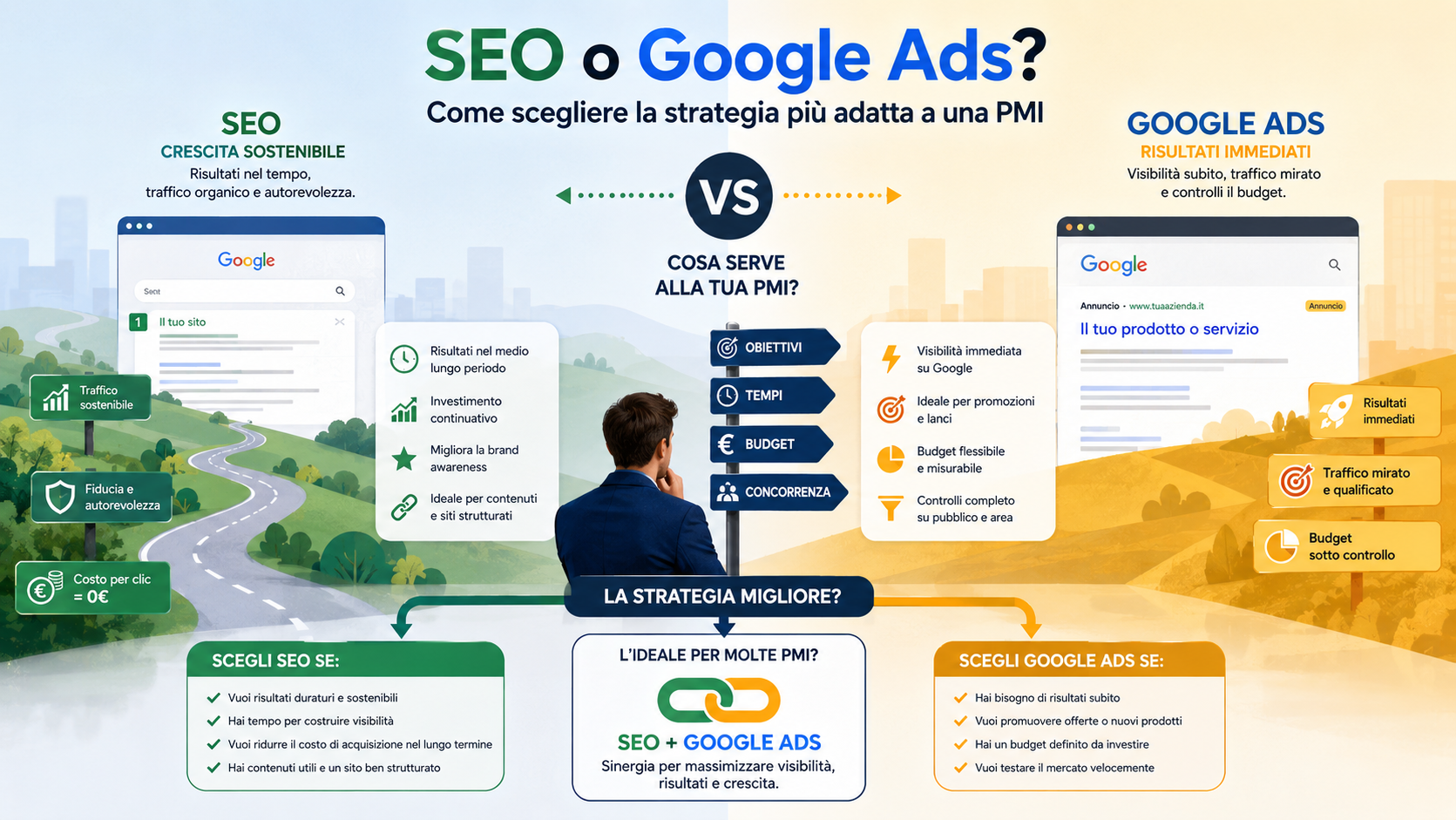
SEO and Google Ads can both connect a business with people searching online for products, services and solutions, but they operate differently. SEO aims to increase a website’s presence in organic results through content, technical structure, authority and user experience. Google Ads provides paid visibility through campaigns with selected audiences, budgets and measurable objectives.
An SME should not base its decision on claims such as “SEO is free” or “Google Ads immediately delivers customers”. Both require investment, expertise, an effective website and reliable measurement. The appropriate strategy depends on existing demand, competition, margins, urgency, the sales cycle and the company’s ability to convert traffic into enquiries or purchases.
What SEO is
SEO stands for Search Engine Optimization. It includes technical, editorial and organisational activities that help Google discover, understand and present website pages in non-advertising search results.
An SEO project may include:
- Research into potential customers’ searches.
- Correction of crawling and indexing issues.
- Improvement of website structure.
- Creation of product and service pages.
- Production of useful informational content.
- Optimization of titles, text, images and internal links.
- Improvement of mobile usability and loading performance.
- Management of the company’s local presence.
- Development of authoritative mentions and links.
- Performance analysis through Search Console and web analytics.
SEO is not simply repeating a keyword. The website must answer genuine user needs, provide credible information and remain technically accessible to search engines.
What Google Ads is
Google Ads is Google’s advertising platform. It allows companies to publish ads across different placements, including search results, Google Maps, partner websites, YouTube and other properties, depending on the campaign type.
For many SMEs, Search campaigns are an appropriate starting point because ads can appear when users search for terms connected with the products or services offered.
A campaign may require:
- Definition of business objectives.
- Selection of geographical areas.
- Keyword research.
- Ad creation.
- Preparation of landing pages.
- Budget and bidding configuration.
- Conversion-measurement setup.
- Search-term reviews.
- Exclusion of irrelevant searches.
- Ongoing campaign optimization.
Paying for advertising does not automatically guarantee sales or the first position. Ads must comply with applicable policies and participate in an auction that also considers relevance, quality and context.
The main difference between SEO and Google Ads
SEO gradually builds a website’s ability to obtain organic visibility. Google Ads purchases immediate access to advertising placements while the campaign remains active and has sufficient budget.
SEO traffic does not involve paying Google for each organic visit, but the business still pays for research, content, development, optimization and maintenance. Google Ads involves both campaign-management costs and the cost of advertising traffic.
When a campaign is paused, its ads normally stop generating traffic. A well-performing organic page may continue receiving visits, although rankings are not guaranteed and the content still requires maintenance.
SEO and Google Ads compared
| Characteristic | SEO | Google Ads |
|---|---|---|
| Visibility | Organic search results. | Paid advertising placements. |
| Initial timing | Usually progressive. | Potentially faster after approval and activation. |
| Cost per visit | No direct payment to Google for an organic click. | Advertising traffic involves a cost. |
| Duration | May continue over time, without ranking guarantees. | Depends on campaign and budget continuity. |
| Control | Less immediate control over position. | More control over budget, location, schedule and messaging. |
| Main purpose | Build medium- and long-term presence and authority. | Generate visibility, test offers and reach existing demand quickly. |
Neither strategy is universally superior. A company can use Google Ads to generate early data and opportunities while simultaneously improving its website and organic content.
When SEO is appropriate
SEO is particularly valuable when a company wants to develop a sustainable presence for important market searches and can invest the time required to produce useful pages and content.
It may be appropriate when:
- Customers regularly search online for the services offered.
- The company has expertise it can communicate.
- Customers need information before purchasing.
- The buying process requires comparison and research.
- The website can be improved technically.
- The company wants to reduce long-term dependence on paid traffic.
- Products and services remain available for a sufficient period.
- Trust and authority influence the decision.
SEO may suit professional firms, B2B companies, service businesses, structured e-commerce catalogues and local organisations that can create genuinely useful content.
When Google Ads is appropriate
Google Ads is useful when the company needs to reach existing demand quickly, promote a specific offer or test whether particular searches generate customers.
It may be appropriate when:
- Enquiries are required relatively quickly.
- A new product or service is being launched.
- A seasonal promotion needs visibility.
- Organic pages are not yet ranking.
- Different commercial messages need to be tested.
- The value of a sale supports the acquisition cost.
- Effective landing pages are available.
- Calls, forms and purchases can be measured.
Campaigns can also protect brand visibility, focus on selected geographical areas and concentrate spending during periods when the company can respond effectively.
When SEO alone may not be enough
SEO alone may be unsuitable when a business requires immediate results, has a short-term promotion or operates in an extremely competitive organic market.
- The website is new and not yet established.
- Demand must be reached immediately.
- The promotion will end shortly.
- Competitors operate highly authoritative websites.
- The company cannot maintain quality content.
- Products change very quickly.
- There is little existing search demand.
Advertising can provide temporary visibility while the company builds its organic presence or validates the commercial offer.
When relying only on Google Ads is risky
Complete dependence on advertising may expose a company to increasing costs, competitive changes and an immediate loss of traffic when spending is reduced.
Google Ads may be inefficient when:
- The website is slow or untrustworthy.
- Pages do not explain the offer clearly.
- Conversions are not measured.
- Commercial margins are insufficient.
- Enquiries are answered too slowly.
- Keywords attract irrelevant users.
- The budget is divided across too many campaigns.
- Search terms and lead quality are not reviewed.
Advertising amplifies the existing customer journey. When the offer, website and sales process are weak, additional traffic may primarily create additional cost.
Analyse demand and search intent
The company should understand what potential customers search for and which stage of the decision process they have reached.
- Informational: the user wants to understand a problem.
- Commercial: the user is comparing providers, products or prices.
- Transactional: the user intends to buy, book or request a quotation.
- Local: the user needs a nearby provider.
- Branded: the user searches for a particular company or product.
SEO can cover the complete journey through guides, service pages, comparisons and case studies. Google Ads is often most efficient when concentrated on searches with clear commercial or transactional intent.
Evaluate budgets, margins and acquisition costs
The decision must be connected with the company’s financial data. The cost of a click alone is not sufficient: the business must know how many visits become leads, how many leads become customers and what margin each sale produces.
- Average sale value.
- Gross margin.
- Lead-to-customer conversion rate.
- Average sales-cycle duration.
- Value of repeat purchases.
- Maximum sustainable customer-acquisition cost.
- Budget required to collect meaningful data.
A subscription or repeat-purchase business may support a higher initial acquisition cost than a business with a single low-margin transaction. SEO costs should also include content, development, consultancy and internal time.
The role of the website and landing pages
Neither SEO nor Google Ads can completely compensate for a website that lacks credibility or makes the desired action difficult.
An effective page should provide:
- A heading consistent with the search.
- A clear explanation of the offer.
- Practical customer benefits.
- Prices or quotation criteria where appropriate.
- Evidence of expertise and reliability.
- Verifiable reviews or case studies.
- Visible calls to action.
- Simple, working forms.
- A good mobile experience.
- Suitable loading performance.
Advertising campaigns may use dedicated landing pages that closely match the ad and search. SEO pages should also be correctly integrated into the website structure and connected with relevant content.
Measure conversions and lead quality
Traffic by itself is not a business result. Strategies should be evaluated through actions that create genuine value.
- Online sales.
- Quotation requests.
- Qualified calls.
- Bookings.
- Form submissions.
- Trial or demonstration registrations.
- Attributable store visits where available.
- Contracts completed after the initial enquiry.
Micro-conversions, such as document downloads, should be distinguished from actions that directly generate revenue opportunities.
Businesses completing sales offline can use a CRM to connect the original enquiry with the opportunity and final sale. This allows optimization based on lead quality rather than only the number of submitted forms.
SEO and Google Ads for local businesses
A local company can combine website optimization, Google Business Profile and geographically restricted advertising campaigns.
Local SEO may include:
- A complete and current Google profile.
- Pages for local services.
- Authentic customer reviews.
- Consistent business information.
- Content concerning the genuine service area.
- Mentions from trustworthy local organisations.
Google Ads may promote the most profitable services, cover selected locations and increase visibility when the business has operational capacity.
SEO and Google Ads for e-commerce
An e-commerce website may contain many products, categories and potential searches. SEO can develop organic visibility for category pages, product pages and guides, while paid campaigns can promote products with suitable availability and margins.
- Product margin.
- Actual inventory availability.
- Competitor pricing.
- Delivery and return costs.
- Website conversion rate.
- Average order value.
- Repeat purchases.
- Demand seasonality.
Traffic should not be directed towards unavailable products, incomplete pages or difficult checkout processes. Catalogue, price and inventory information must remain consistent.
SEO and Google Ads for B2B companies and professionals
In B2B and professional services, customers may require weeks or months to decide. The number of enquiries may be lower, while the value of each opportunity may be considerable.
SEO can support this process through:
- Detailed service pages.
- Technical articles.
- Case studies.
- Answers for decision makers.
- Solution comparisons.
- Industry-specific content.
Google Ads can reach highly specific searches and direct users towards consultations, demonstrations or contact requests. Performance should be measured through genuine opportunities and contracts, rather than cost per form alone.
Why an integrated strategy is often best
SEO and Google Ads can provide useful information to each other. Advertising allows a company to test search terms, offers and messages quickly. This information can guide the development of future SEO pages and content.
SEO can improve:
- Landing-page quality and completeness.
- Understanding of customer requirements.
- Perceived website authority.
- The number of organic entry points.
- The ability to convert paid traffic.
An SME may use ads for searches closest to a sale and SEO for informational questions, comparisons and strategic long-term searches.
A 90-day operational plan
- Define priority services, products and margins.
- Identify audiences and geographical areas.
- Research informational, commercial and transactional searches.
- Review website structure and indexing.
- Check mobile usability, speed and forms.
- Configure analytics, Search Console and conversion measurement.
- Create or improve priority service pages.
- Prepare a limited advertising campaign.
- Set a sustainable test budget.
- Review search terms and incoming enquiries.
- Create SEO content based on genuine requirements.
- Record leads in a CRM or shared system.
- Compare costs, leads, sales and commercial quality.
- Reduce inefficient activities and expand successful ones.
The initial period should generate reliable information. Constantly changing campaigns, pages and objectives makes it difficult to understand what produced the result.
Common mistakes to avoid
- Assuming SEO is completely free.
- Expecting guaranteed organic positions.
- Believing the highest budget always wins the first advertising position.
- Sending all traffic to the home page.
- Failing to configure conversion measurement.
- Measuring only clicks and impressions.
- Ignoring margins and lead quality.
- Using excessively broad keywords.
- Creating SEO content only for search engines.
- Failing to review search terms.
- Depending completely on automation without reliable data.
- Stopping SEO after early improvements.
- Changing campaigns without sufficient evidence.
- Failing to train employees who handle enquiries.
Success depends on the complete journey: search, advertisement or organic result, landing page, enquiry, sales response and completed purchase.
The role of Azienda Digitale
In this context, Azienda Digitale can support SMEs, professionals and e-commerce businesses in choosing SEO, Google Ads or an integrated strategy. The process can begin with an analysis of demand, competitors, website quality, margins and sales procedures.
Support may include SEO audits, keyword research, technical optimization, page creation, editorial planning, campaign configuration, landing pages, conversion measurement and CRM integration.
The objective is not simply to increase visits and clicks, but to generate sustainable opportunities. The strategy should be measured through qualified enquiries, sales, margins and long-term value.
Frequently Asked Questions
Should a company invest in SEO or Google Ads first?
It depends on urgency, website quality and existing demand. Google Ads may generate visibility and data more quickly, while SEO progressively builds organic presence. A limited advertising project can often run alongside the development of priority SEO pages.
Is SEO really free?
Google does not charge for organic clicks, but SEO requires investment in research, content, development, tools, maintenance and expertise. Its cost must be compared with the results generated over time.
How much budget is required for Google Ads?
There is no universal amount. It depends on the market, location, competition, sale value and conversion rate. The initial budget should collect meaningful data without exceeding the company’s sustainable acquisition cost.
Does Google Ads improve organic rankings?
No. Participation in advertising programmes does not directly improve or reduce organic rankings. Advertising and organic search use separate systems.
Can SEO and Google Ads be used together?
Yes. Ads can reach highly commercial searches quickly, while SEO develops organic visibility, content and authority. Information from both channels can improve the complete strategy.
Would you like to understand whether your company should invest in SEO, Google Ads or an integrated strategy?
Azienda Digitale
can help you analyse demand, website quality, budgets and objectives and build a practical plan focused on qualified leads and sales.